
Abraham Lincoln: Part One
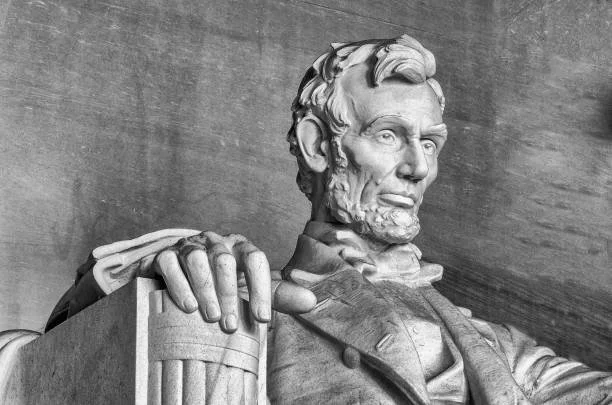
Abraham Lincoln’s story begins in the rough borderlands of early nineteenth-century America, a world shaped by migration, hard labour, and the steady westward push of families seeking land of their own. He was born on February 12, 1809, in a one-room log cabin on the Sinking Spring Farm near Hodgenville, Kentucky. His parents, Thomas and Nancy Lincoln, lived a life that reflected the uncertainties of the frontier. They were not poor in the sense of destitution, but they were constantly vulnerable to the whims of weather, illness, and—more significantly—land disputes. It was one of these disputes that set in motion the family’s first great relocation and shaped the childhood of the future president.
Thomas Lincoln, despite being hardworking and respected locally, found himself entangled in unclear land titles, a common problem in Kentucky. Kentucky’s system of overlapping claims meant that even an honest farmer could lose everything to an unexpected challenger. After repeated disputes, Thomas decided to move his family north into Indiana, a territory whose land laws seemed clearer and whose promise of stability was more appealing. In December 1816, the Lincolns crossed the Ohio River and settled in what would become Spencer County.
Indiana offered fresh soil, but it also presented hardship. The land needed to be cleared, hunted, and coaxed into productivity. Abraham, only seven when he arrived, grew up with an axe in his hands. He later said that his youthful labour “went chiefly for the support of the family,” an understated way of describing the relentless physical effort frontier farming demanded. Yet this work shaped him. The physical strength he gained, the endurance he cultivated, and the quiet time he spent walking through forests or reading by firelight all became threads woven into the texture of his character.
Tragedy soon struck the family. In 1818, Nancy Lincoln died suddenly of “milk sickness,” an illness caused by drinking milk from cows that had fed on the toxic white snakeroot plant. The loss devastated Abraham, who was only nine years old. The household fell into disarray until Thomas returned from a journey to Kentucky with a new wife, Sarah Bush Johnston, a widow with children of her own. Sarah quickly became a stabilising figure, treating Abraham with affection and encouraging his love of reading. It was she who fostered the intellectual dimension of his life at a time when formal schooling was scarce. By Lincoln’s own later estimate, the total amount of time he spent in actual classroom education barely exceeded one year—but thanks to his stepmother, he had access to books and emotional space to learn.
Books, once introduced into his life, became his companions. He read the Bible, Aesop’s Fables, Pilgrim’s Progress, Robinson Crusoe, and biographies of George Washington and Benjamin Franklin. These works formed the backbone of his moral universe. He absorbed their lessons, repeating stories, copying passages into homemade notebooks, and cultivating a habit of self-education that would sustain him long after he left home.
In 1830, restless again and facing a series of poor harvests and an outbreak of milk sickness in Indiana, the Lincolns uprooted once more. This time, they travelled to Illinois. Abraham, now twenty-one, was strong, tall, and beginning to define himself as separate from his parents. After helping the family build their new home in Macon County, he struck out on his own, eventually settling in the small village of New Salem.
New Salem, perched on a bluff above the Sangamon River, was a crossroads community full of young men seeking opportunity. Although the village would eventually disappear, it played a decisive role in Lincoln’s development. He worked as a store clerk, mill hand, and postmaster; he surveyed land, split rails, and entered into the lively social culture of debates, storytelling, wrestling, and political discussion. Lincoln’s quick wit and good-natured humour made him popular, while his honesty—so notable that he earned the nickname “Honest Abe”—established a reputation that followed him for the rest of his life.
His reading broadened. By borrowing books from local neighbours such as Jack Kelso and Mentor Graham, he delved into Shakespeare, Burns, English history, grammar, and mathematics. He practised writing speeches, sharpened his skill in argument, and developed a clearer vision of the world beyond the frontiers.
Opportunity appeared in 1832 when the Black Hawk War broke out. Lincoln volunteered for the Illinois militia and was elected captain by his peers, an early hint of his natural leadership. Although he saw no combat, the experience solidified his standing among local men and nudged him toward public life.
Later that year, he made his first bid for political office: a run for the Illinois General Assembly. He campaigned on improving navigation of the Sangamon River, supporting internal improvements, and fostering local growth. He lost—badly—but he gained enough votes in his home precinct to realise that people believed in him.
Determined to succeed, he began building the foundations of a political career. After New Salem’s store where he worked went bankrupt, leaving him in deep debt, Lincoln resolved to study law. The idea appealed to him partly because the law offered a path upward, and partly because it suited his temperament. He read legal texts diligently and began to apprentice himself informally to local lawyers.
In 1834, he ran for the General Assembly again—this time successfully. He joined the ranks of the Whig Party, a political movement that championed economic development, education, infrastructure, and a cautious, reasoned approach to governance. Lincoln’s Whig identity became the ideological compass of his early career, guiding his votes and the causes he championed. He believed in the power of government to build roads, canals, and institutions that lifted the entire population. He believed equally in the principle of self-improvement, the idea that every person should have the chance to better themselves through education and hard work, just as he had done.
Serving four terms in the Assembly between 1834 and 1842, Lincoln became known for his clear thinking, dry humour, and talent for persuasion. He aligned himself with influential figures like John Todd Stuart, who helped him secure his law licence. In 1837, Lincoln moved to Springfield, Illinois, the state capital. Springfield would be his home for nearly a quarter-century and the stage upon which most of his pre-presidential life unfolded.
Law became both his profession and his training ground. He joined the firm of Stuart and Lincoln, later partnering with Stephen T. Logan and eventually with William Herndon. Lincoln’s law practice was extensive and demanding. He travelled the Eighth Judicial Circuit on horseback and by buggy, riding from county to county to argue cases ranging from murder trials to debt disputes. The circuit court system served as a microcosm of the region: farmers with boundary disagreements, mill owners suing over contracts, families wrestling with estates, and local businesses caught in financial knots. Lincoln navigated it all with diligence and growing expertise.
His courtroom presence was distinctive. He was methodical, patient, and disarmingly plainspoken. He did not thunder or posture. Instead, he built arguments step by logical step, using stories, analogies, and the occasional burst of humour. His sense of fairness shaped his approach; he discouraged dishonest claims and was known to withdraw from cases he found morally dubious. The practice of law refined his analytical mind and sharpened the rhetorical abilities that would later electrify national audiences.
Parallel to his legal career, Lincoln’s political ambitions continued. In 1846, he was elected to the U.S. House of Representatives, serving a single two-year term. Washington broadened his perspective, but it also brought challenges. The Mexican–American War loomed large during his tenure, and Lincoln questioned the justifications for it, particularly President Polk’s claim that American blood had been shed on American soil. While principled, his stance was unpopular among many of his constituents, contributing to his decision not to seek re-election.
Returning to Springfield, he resumed his law practice and temporarily stepped back from public office. The 1850s, however, reshaped the political landscape of the United States in ways that would draw Lincoln back into the national conversation. At the heart of the growing tension was the question of slavery and its expansion into new territories.
The Kansas–Nebraska Act of 1854, introduced by Senator Stephen A. Douglas, effectively repealed the Missouri Compromise by allowing settlers in new territories to decide for themselves whether to permit slavery. This policy of “popular sovereignty” inflamed the country. To Lincoln, the issue cut to the core of the nation’s principles. He believed slavery was morally wrong, and while he did not advocate abolition in states where it already existed, he argued forcefully that it should not be allowed to spread.
The passage of the Act pulled Lincoln back onto the political stage. He delivered speeches across Illinois that combined legal reasoning, moral argument, and historical reflection. One of his most important early speeches in this period took place in Peoria in October 1854, where he outlined a comprehensive critique of slavery’s expansion and the dangers it posed to the country’s founding ideals. The speech revived his political career and positioned him as a key figure in the emerging Republican Party, which coalesced around opposition to the spread of slavery and support for free labour.
Lincoln’s rivalry with Stephen Douglas intensified as the 1850s progressed. Douglas, a skilled and charismatic Democrat, dominated Illinois politics. Lincoln challenged him repeatedly, culminating in the celebrated Lincoln–Douglas debates of 1858. These seven debates, held across Illinois during their race for the U.S. Senate, showcased contrasting visions for the nation’s future. Douglas defended popular sovereignty; Lincoln argued that the nation could not endure permanently divided between slave and free states.
Although Lincoln lost the Senate race, the debates elevated him to national prominence. Newspapers across the country reprinted his words, and many Americans encountered him for the first time through these printed transcripts. His clarity of thought, moral consistency, and ability to develop arguments in plain, accessible language won him admiration far beyond Illinois.
Between 1858 and 1860, Lincoln continued to speak, write, and organise politically. His Cooper Union Address in New York in February 1860 proved decisive in cementing his national reputation. Addressed to an audience of influential Northerners, the speech traced the views of the Founding Fathers and demonstrated, through careful historical evidence, that they opposed the expansion of slavery into the territories. The address was a triumph. It positioned him as a thoughtful, principled figure—firm but not radical, moral without being incendiary.
As the Republican Party approached its national convention in Chicago in May 1860, Lincoln emerged as a strong contender. His moderate reputation, Western roots, and growing popularity made him a unifying figure for a party that sought a candidate who could appeal broadly across free states. Delegates considered several prominent figures—William H. Seward of New York chief among them—but Lincoln’s careful positioning and strategic support within the convention hall ultimately secured him the nomination.
The presidential campaign that followed relied heavily on Lincoln’s image as a humble, self-made man: the rail-splitter turned lawyer, the frontier youth turned statesman. His ability to connect his life story with broader American values gave the campaign an authenticity that resonated with voters. Portraits and biographies circulated widely, presenting a man whose honesty, work ethic, and moral compass embodied the aspirations of the country.
On November 6, 1860, Abraham Lincoln was elected President of the United States.
His journey—from a log cabin on the Kentucky frontier to the highest office in the nation—was the culmination of decades of self-education, perseverance, moral conviction, and a belief in the promise of ordinary people rising through their own effort. The story up to this point is one of movement and growth, of a mind sharpening itself against books, debates, and legal cases, of a character forged in hardship but guided by a steady sense of justice. His election marked the beginning of a new chapter in American history, one rooted in the long rise that preceded it.