
The Philosopher King
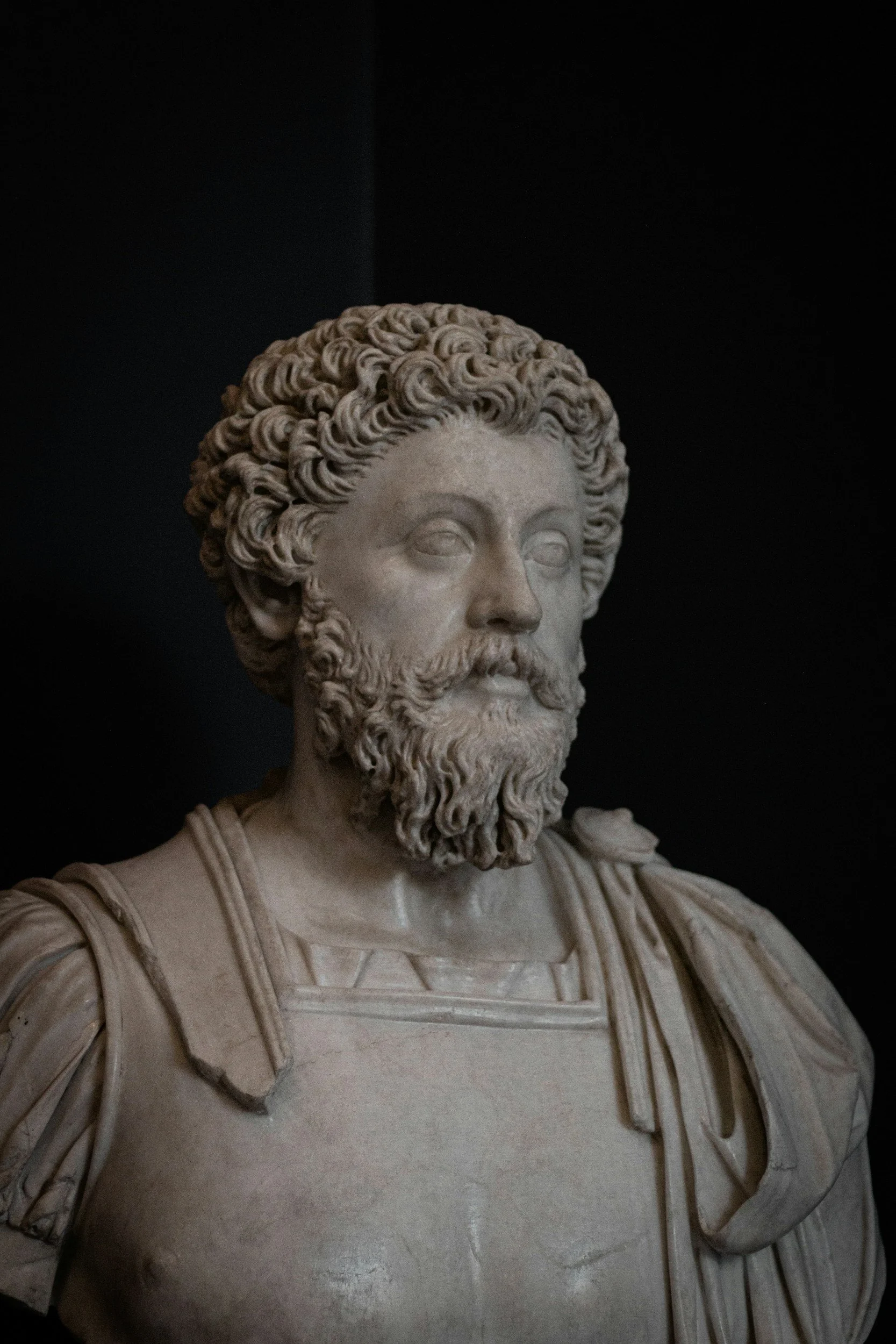
Marcus Aurelius’ Meditations is where nearly all who are interested in philosophy have their “aha” moment.
Nearly two thousand years ago, a Roman Emperor sat alone in a war camp, writing notes to himself about patience, perspective, and peace of mind. Those notes became Meditations, a book that, against all odds, still speaks directly to us today. Marcus Aurelius didn’t write for fame or followers; he wrote to survive his own thoughts. And in doing so, he left behind one of the most honest self-help books ever written.
Marcus Aurelius, AD 121 to 180, is the classic philosopher-emperor. He carried a battered empire on his back and still found time to write notes to himself about patience, duty, and perspective. Public life was relentless. Private life was reflective. Put together, his story is a masterclass in staying steady when the world is anything but.
From bookish kid to heir of an empire
He was born in Rome on 26 April 121 into a wealthy, well-connected family. As a teenager he fell in love with philosophy, especially Stoicism. He wore simple clothes and lived simply because he wanted a clear head. Then in 138 everything changed. Hadrian adopted Antoninus Pius, and Antoninus adopted Marcus and Lucius Verus. One minute he was buried in books, the next he was on a path to the throne. He married Antoninus’ daughter, Faustina the Younger, in 145. Family and state became the same thing.
Training under Antonius Pius
Antoninus ruled for 23 calm years. For Marcus it was a long apprenticeship in the slow, careful work of running a giant system. Hear petitions. Fix messy disputes. Keep the law fair. Hold your nerve. If Hadrian was restless energy, Antoninus was steady gravity. Marcus learned that rhythm and added his own philosophical discipline.
An unforgiving reign
Marcus became emperor in 161. He chose to share power with Lucius Verus. Rare, but smart. Then the storm hit. War with Parthia in the east. Victory came, but the troops brought back a killer. The Antonine Plague rolled across the empire for years. It likely took Lucius in 169. With soldiers and citizens dying, pressure built on the northern frontier. Germanic and Sarmatian tribes pushed along the Danube. Marcus spent much of his reign in military camps, not palaces. Between cold nights and supply headaches he wrote the private notes we now call Meditations.
The family man behind the laurel
Marcus and Faustina had at least 13 children. Many died young, which was common in those years and even worse during the plague. Their son Commodus, born in 161, survived. He was made Caesar in 166 and co-emperor in 177. Continuity mattered when war and disease ate through the state. History has not been kind to Commodus, but the choice made sense at the time. Marcus tried to build character around his children with good tutors and strong habits. He could not give them his temperament, but he tried to give them tools.
The stoic on the throne
Marcus did not write to impress. He wrote to cope. Stoicism says you cannot control events, you can control your response. For an emperor that means a clear head when envoys lie, when a general fails, when the river freezes and the border lights up. For the rest of us it is the same pattern on a smaller stage. Choose integrity. Do the part that is yours to do. Let the rest go.
He tried to govern that way. Fair law. Push back on corruption. Sell palace treasures when money ran tight. No drama, just action. None of it made the plague vanish or the frontier quiet, but it showed a ruler refusing to panic.
Death and the shadow that followed
Marcus died on 17 March 180, probably at Vindobona, now Vienna, or at Sirmium, still on campaign. Commodus took over and chased spectacle. For centuries writers compared the father’s discipline with the son’s theatrics. It turned Marcus into a moral measuring stick. Even without that contrast, his legacy stands. Leadership under pressure. Private accountability in public life. Proof that power does not cancel suffering, it raises the stakes.
The Emperor and the Everyman
Marcus ruled the world, but he struggled with the same frustrations most of us do — stress, anger, and self-doubt. “Don’t be overheard complaining, not even to yourself,” he tells himself, trying to stay level-headed while managing an empire. That’s not far off from anyone today trying to keep calm through deadlines, family drama, or the endless buzz of notifications.
We often imagine emperors as superhuman, but Marcus reminds us that power doesn’t protect you from the chaos of your own mind. His reflections read less like royal proclamations and more like quiet journal entries from someone desperate to stay decent in an indecent world.
Stoicism and the Modern Mind
At the heart of Meditations is Stoicism, the philosophy that while you can’t control what happens, you can control how you respond. It’s the same principle that powers modern cognitive behavioural therapy (CBT). Marcus puts it simply: “You have power over your mind, not outside events. Realize this, and you will find strength.”
That’s as relevant today as it was in ancient Rome. Whether you’re dealing with online criticism, job insecurity, or just bad traffic, Stoicism gives you the same anchor Marcus used: focus on your reaction, not your circumstances.
Pressure, Ambition, and Modern Burnout
Imagine having the weight of an empire on your shoulders. Every decision affects millions. Yet Marcus worries about the same emotional traps that plague the rest of us: overwork, ego, and the constant need for approval. “Ambition means tying your well-being to what others say or do,” he writes, a perfect diagnosis for the social media age.
We chase validation through likes, titles, and possessions. Marcus, writing from a marble palace, realized how empty that pursuit can be. His Stoicism wasn’t about rejecting ambition; it was about freeing yourself from being ruled by it.
Mortality and Meaning
Death appears again and again in Meditations, not as something to fear, but as a way to sharpen perspective. Marcus writes, “You could leave life right now. Let that determine what you do and say and think.”
It’s brutal honesty, but freeing. It pushes us to live with intention - to stop scrolling through distractions, to let go of grudges, to treat time like the rare thing it is. Marcus used mortality as a compass, and that lesson has aged better than any empire could.
The Struggle to Practice What You Preach
The beauty of Meditations lies in its imperfection. Marcus constantly fails his own advice, he gets angry, tired, disillusioned. But then he writes again, reminding himself to try once more.
That’s what makes his words feel alive. He wasn’t lecturing from a podium; he was wrestling with himself in real time. Anyone who’s tried to break a bad habit, stay calm through chaos, or keep promises to themselves will recognize that struggle immediately.
Why Meditations Still Matters
The world has changed beyond recognition since Marcus Aurelius ruled it, yet human nature hasn’t. We still crave meaning, stability, and peace in the face of uncertainty. Meditations endures because it offers no shortcuts, only practice. It teaches that happiness comes from discipline, not luck; from inner control, not external chaos.
Marcus reminds us that philosophy isn’t about lofty theories, it’s about living better today. And in that sense, the emperor’s words are still the most democratic thing imaginable: timeless advice from one person trying to stay human, offered to anyone else trying to do the same.
Key Takeaway:
Meditations is proof that even an emperor had to fight the same battles we do - the ones within ourselves. His world may be gone, but his message remains: control your mind, live with purpose, and don’t let the noise of the world drown out the peace you can build within it.